Eugene Onegin, a Russian Gay Gentleman - fragment
[excerpt] To resume again...
Philippe Sollers,
un vrai roman
J - A MILLER
A Political Variant of the Subject-of-Truth
ALAIN BADIOU
A Spectacular Health
MARCO FOCCHI
A Reading of the Seminar From an Other to the other III
J - A MILLER
Freud, so to Speak
JEAN-LUC NANCY
Eugene Onegin,
a Russian Gay Gentleman
SLAVOJ ZIZEK
Gispert,
Mellor, Neshat
CATHY LEBOWITZ
interviews
JOSEFINA AYERZA
Intercepts
ALAIN BADIOU / THOMAS SVOLOS

 In our Politically Correct times, it is fashionable to discern homosexuality in the musical texture of some classic composers and thus redeem them - there are, for example, totally unconvincing and ridiculous readings of Schubert: he must have been gay, because his music is non-aggressive/penetrative/phallic, full of soft passages... In the case of Eugene Onegin, however, we stand on a much more firm ground. In the Fall of 1876 Tchaikovsky informed his closest family members of his intention to marrya typical hysterical passage à lacte, an act of ethical betrayal, of compromising ones desire, i.e., a desperate attempt to thwart his homosexuality. Half a year later, the eagerly awaited answer of the Real cameAntonina Milyukova, his piano student a couple of years before, wrote to him, declaring that she was in love with him ever since. Tchaikovsky tactfully but firmly rejected her, and, at this precise moment, he threw himself into composing Eugene Onegin (starting with Tatyanas letter to Oneginhe was already for some time playing with the idea of making a song out of this letter). As he later admitted, from this moment onwards, fact and fiction became inextricably entangled: he identified with Tatyanas love for Onegin and was outraged at Onegins moralistic rejection, perceiving it as equal to his own rejection of Antonina. Consequently, he contacted Antonina again, telling her bluntly that he doesnt love her, but is ready to marry her; he then left Antonina to make all the wedding preparations, while he escaped Moscow to a friends country estate, where he composed two thirds of the opera in five weeks. What followed is well known: the honeymoon was a nightmare, the desperate Tchaikovsky tried suicide and then quickly left his wife for a long tour of Western Europe.
[...]
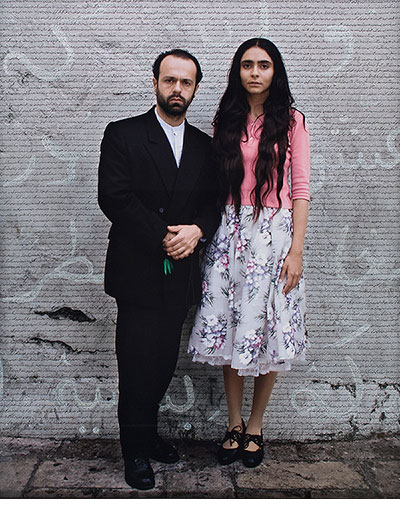
Faezeh and Amin Khan - C-print and ink, 2008
courtesy Barbara Gladstone Gallery, NYC.
Subscribe to Lacanian Ink click here.
Purchase Lacanian Ink