Why the Idea and Why Communism?
Translated by Asunción Álvarez, Miller’s “Le Séminaire inexistant: L’orientation lacanienne II, 11: Leçons 1 et 2, was published as “Comentario del Seminario inexistente,” in Manantial, Buenos Aires, 1992, and as “De la nature des semblants ” in Carnets cliniques de Strasbourg, 1999, n°1.
At the end of our previous meeting I told you that we would try to carry out a line-by-line reading of the non-existent seminar. This seminar does not exist, precisely, due to a censorship effect, Lacan’s self-censorship, which he rightly ascribes to heterocensorship by the International Association. But what censorship suppresses or cancels can be read nonetheless in the traces left by this operation. It can also be read between the lines, which is what we will be attempting now.
Given that this cancellation leaves a trace in Lacan’s work, some of its pages can be referred to this non-existent seminar, of which, as I reminded you last time, we have the first session. Thus we have material enough to work this year, in which our topic is the nature of semblances. And let us add that semblance of the father is, if not the main one, one of the most important semblances.
Diology
Let us start with a footnote in page 852 of the Écrits: “Pusimos en reserva -dice Lacan- el Seminario que habiamos anunciado para 1963-4 sobre el Nomebre-del-Padre, despues de haber cerrado su leccion de apertura (nov.63) [EXACTAMENTE, EL 20 DE NOVIEMBRE] sobre nuestra dimision al cargo de Sainte-Anne, donde nuestros seminarios tenian lugar desde hacia diez anos.” This was Lacan’s second resignation. The first one, which had taken place in 1953, had led him to leave the International Association against his will. For it had not been his intention to give up the Paris Psychoanalytical Society. Through a mistake, he found himself, together with his colleagues at that time, expelled from the psychoanalysis organization created by Freud.
His resignation from his post in Sainte-Anne in 1963 confirmed this exclusion. Removed, as I said, by his French colleagues from the list of training analysts, his response was a resignation that led him to change his direction. The first ten years of the Sainte-Anne seminar and the two previous years of the seminar, held privately in his home, addressed an audience that was mainly composed of analysts, both in training and working. The 1963 resignation from Sainte-Anne led him, two months later, to address all Latin Quarter audiences from then on. After that, the Freudian cause ceased to be exclusively in the hands of specialists. And this transference shows only to him the specialists’ failure and the fact that the return to Freud took place by way of a displacement, a change of place. Maybe reserving the seminar of the Names of the Father, whose subject was the Name-of-the-Father in the singular, made provisional sense to Lacan in this 1966 footnote (and this is, moreover, what is implied by the verb to reserve – that is, to keep something available), which however became explicitly definitive later on – after 1967 – in a different work.
The footnote on page 852 is a note to the following sentence in the main text: “I am inconsolable at having had to drop my project of relating the function of the Name-of-the-Father to the study of the Bible.” (p 742) This sentence provides us with a very precise indication on the aim of the seminar that has become non-existent regarding the particular procedure Lacan intended to use to relativize the Name-of-the-Father. Referring its function to Bible study thus amounted to underlining, working, elaborating on the idea that the Name-of-the-Father depends on a tradition. Whatever logical, structural function one might wish to ascribe to it, this name does not belong in the discourse of science as such, but rather in a tradition which has been unbroken for five thousand years, apparently – the Jewish tradition, which is, after all, the mainstay of the Western tradition.
>Truth be told, the Western tradition, as James Joyce rightly pointed out, is oddly enough, both Greek and Jewish. From the Greeks we get God’s relation to being, elaborated with the passage of time; and from the Jews, God’s relation to the Real. One might rightly think that the reference to Bible study in the non-existent seminar was a stab at disentangling both relations. This opposition was well located by Pascal in his Pensées when he opposed the God of philosophers of his own time to the God of Abraham, Isaac and Jacob; and it is also reflected for us in our distinction between the god of the subject supposed to know and that of object a.
The topic is fully presented in a page in something Lacan wrote and which I will gladly assign to the non-existing seminar – in any case, it clarifies it and helps us to read it. This is the text entitled “The mistake of the subject supposed to know”, which you will find on page 34 of Momentos cruciales de la experiencia analitica. I will read you this passage: “La equivocacion del sujeto supuesto al saber. Dios mismo para llamarlo con el nombre que le da Pascal, cuando se precisa su contrario: no el Dios de Abraham, de Isaac y de Jacob, sino el Dios de los filosofos…” This quotation, this equivalence established between the subject supposed to know – a function of the analytical experience – and the god of philosophers, is accompanied by a sarcastic critique of ecumenism, which at that time was de rigueur in the Roman Catholic Church as part of its aggiornamento. We also find this critique in page 742 of the Écrits: “Ecumenism only seems to have a chance if it is grounded in an appeal to the feebleminded.”
This repeated sarcasm has a very precise theoretical value: ecumenism involves the search for the common denominator to the deities of different religions and beliefs, and then the removal of what are regarded as the details of these beliefs. And this can only converge in the god of philosophers, the subject supposed to know; whereas the root of beliefs, its very energy, does not come from there, but from that other god that is in the Jewish tradition – and in the religions derived from it – the god of Abraham’s sacrifice. This god is rather a subject supposed not to want to know anything at all concerning man’s affects, who spits in the milk of human kindness, if I may put it like that. He is such an inhuman god – a god who ignores man as much as Schreber’s god does at the start of his delusional Memoirs. The ecumenical god, by contrast, is a subject not only supposed to know, but who also wants the good of man, a sort of Santa Claus. Indeed, Santa Claus proved to be God the Father, capable of turning into the very symbol of consumption – not only a god of being but a god of having – by means of a conversion that is emblematic of the current stage of our civilization (where, as can be ascertained, those who haven’t reached it yet aspire to join us).
The return to Bible study, which was Lacan’s ambition, involved the return to the vigor of the original tradition, to which we owe the Name-of-the-Father. The non-existing seminar is a return to the Bible as the core of what is upheld by Freud himself, as heir to this tradition, which he made use of in order to mask what Lacan tries to bring to light as the scandal of psychoanalysis, both with regard to this tradition and to the discourse of science. Moreover, Lacan wished to remind us in this seminar that the first of the names of the father is God the Father, whose outline can be seen behind Oedipus’s father.
Then in “The mistake of the subject supposed of knowledge”, a conference of December 1967 in Naples which was never delivered (it was replaced by an improvisation which, as far as I know, left no traces), there is something that completes or seals the reference on page 852 of the Écrits: “Ese lugar de Dios-el-Padre es el que designe como Nombre-del-Padre y el que me proponia ilustrar en lo que debia ser el decimotercer ano de mi seminario (mi undecimo en Sainte-Anne) cuando un paseje al acto de mis colegas psicoanalistas me forzo a ponerle punto final despues de mi primera leccion. Nuna retomare ese tema, pues veo en el que ese sello no podria aun ser abierto por el psicoanalisis.” The word seal has here the value of the sealing, the closing of a message, as with a letter that cannot yet be opened and read. We are trying to open it and see how throughout his teaching, by means perhaps more discreet, Lacan effectively broke the seal that encloses within psychoanalysis its holy of holies, the room that must not be entered, where mystery dwells.
In these pages of “The mistake of the subject supposed of knowledge”, which I am attributing to the non-existent seminar so as to be able to read it, Lacan distinguishes very precisely between two discourses on God: theology, the traditional term which he highlights by distinguishing between both components (theo-logy), and what he amusingly terms, coining a neologism, diology (this time he uses the Latin name of God to establish a difference). He claims that theology is always theory, and all that is of the order of theoria – taking up the Greek term to stress the contemplative aspect of this concept – is, in his view, “theology’s place-in-the-world”.
The fact that the theological discourse on God has a place in our world under the form of theory means that the subject supposed to know, who elaborates theology in particular, is present as masked or, as Lacan puts it, as latent in theory. Moreover, the subject supposed to know is the essential mistake of the subject of theory, which means that theoretical knowledge is ascribed to a subject who already has that knowledge. Hence according to Lacan at least, there are no atheistic theories, even though they may be believed to exist; in particular, when in the name of a theory someone opposes the notion of God, God is preserved, because the supposition is preserved that the knowledge in question is already there.
To this theology then, Lacan opposes diology, and he gives a list of its Fathers – not of the Church but of this anti-Church: Moses, Master Eckhart, and James Joyce as other possible stations of the non-existent seminar, which we might suppose was a seminar of anti-theological diology. Lacan says that, in his view, it was Freud who best marked the place of this diology that he invented and which is not the discourse on the god subject supposed to know but rather the god of the object a. He clarifies in page 21 of Momentos cruciales de la experiencia analitica: “Como lo dije: sin ese lugar marcado, la teoria psicoanalitica se reduciria a lo que es, para mejor o para peor, un delirio de tipo schreberiano.” One might well think that the phrase as I said refers very precisely to a sentence in his “Proposicion del 9 de octubre” of 1967 – that is, of the previous month where we read: “…retiren el Edipo, y el psicoanalisis en extension, dire, se vuelve enteramente jurisdiccion del delirio del presidente Schreiber.” It’s only logical!
I am advancing step by step for we will read these pages as though they were part of the non-existent seminar. Thus, we must move cautiously, testing the consistency of this construction that we are rebuilding. And it is consistent to posit the idea that the Oedipus complex is the place characterized by diology, that the Oedipus complex is a logos, the psychoanalytic logos, the psychoanalytic form of the discourse on God the Father.
>Lacan relativizes the Name-of-the-Father when he claims that this father, the father of the famous paternal metaphor, is nothing but the place of God the Father. Then he encourages us to establish a firm distinction within psychoanalytic theory between the subject supposed to know and the Name-of-the-Father, and to perceive all that is supported by a confusion between both terms, demanding us to revise the results of these confusion in analytic technique itself, even in the semblance of the psychoanalyst. The Name-of-the-Father, which is in the place of God the Father, should not be confused with the subject supposed to know, the essential mistake as regards theory.
A very gaping relation
Let us now return – in order to try and open it – to the seal that closes the holy of holies of psychoanalysis. I will take up the following sentence by Lacan: “Em efecto, la posicion del psicoanalista esta suspendida a una relacion muy hiante. Pero no solo a ella, pues se le requiere que construya la teoria de la equivocion esencial del sujeto en la teoria: lo que llamos el sujeto supuesto al saber.” I extract two propositions from this: according to the first one, the psychoanalyst’s position depends on a … relation. But which one? Apparently, he doesn’t say. Secondly, the theory of the subject supposed to know is not in itself enough to account for it. In this sense, he provides the following example or complement. Beyond the theory of the subject supposed to know, a theory is needed that will include a gap that must be encountered on all levels, inscribed here as indeterminacy, there as certainty, and constituting the knot of the non-interpretable. This is what I struggle towards, while not ceasing to experience its unprecedented atypicality. The question here is: who am I to dare carry out such an elaboration? The answer is simple: a psychoanalyst. The answer will suffice if its scope is limited to that which is proper to the psychoanalyst in me: namely, practice.
>This is a passage which I used to gladly quote in the past, which has become classic yet I am reviewing again today. I am carrying out once again an inquiry into the nature of the double inscription of a gap as indeterminacy and certainty to which a third term is added: the non-interpretable, the knot of the non-interpretable. I am trying to read the non-existent seminar with the help of these indications. In the end, I am not surprised that this passage ends with the term practice, and that Lacan only claims, for this elaboration, the title of having a psychoanalyst’s practice.
And why use the term practice if not to oppose it, precisely, to theory? If psychoanalytic theory has the chance of overcoming the mistake of the subject of theory, it does so inasmuch as whoever elaborates it does so in accordance with his or her own practice. Secondly, the term practice suspends the interrogation on being a psychoanalyst. When he answers that he is carrying out his elaboration in his capacity as a psychoanalyst, Lacan clarifies that this is not because he has his being – which is problematic – but because of his practice. From this point of view, the indeterminacy in the being of the psychoanalytic subject maybe corresponds to the certainty which the psychoanalyst could extract from his or her practice, or more accurately, from his or her act. If you read this passage, you will see that the indeterminacy of the subject is opposed to the certainty of the act. Indeed for Lacan, certainty always seems to escape contemplation and to be the result of the act. Remember his sophism on logical time, conceived to show that on this side of the act, there is only the impossibility to conclude, and that the act is required for verification, in this case of being – to know what is at stake in psychoanalysis. Hence Lacan claims it is a gap that establishes the law of the act. For it is beyond the act and through the act that what could only be doubted previously is verified – that is, the affect generated by indeterminacy.
The psychoanalyst, as Lacan has it, is determined by a structure which he should make himself equal to: that of the mistake of the subject supposed to know. He then offers us two possibilities of what this self-equalization involves. On the one hand, it might involve a self-equalization in its mental form, that is, the representation of the mistake – which leads to a dead end, as this structure is not representable. It bursts it, if I may say so, it doesn’t stay long enough to be contemplated. Thus it does not fulfill the condition for any representation that it must have a certain duration. That is why Lacan said in is last seminars that he would be talking about topology and time. On the other hand, the self-equalization might be with respect to the very position of the subject as it is inscribed in the Real, namely, through the act, which might touch the Real. From this point of view, Lacan tries to define what position of the subject makes him or her capable of the analytic act.
>But, what does it mean to say that the analyst is determined by the structure of the mistake of the subject supposed to know, and why does this posit an essential and non-solvable problem for its definition? It would be easy to define the psychoanalyst by means of the acquisition of a certain knowledge, as in University. What is a diploma but the guarantee that through learning, a certain level of knowledge was attained? It is the Begriff, the ‘concept’, but also the ‘conquest’, the ‘acquisition’. In French universities, the first level of the gradus is called, amusingly enough, maîtrise, mastery, which means that students are ready to succeed in the career which they are starting, in such a way as to be able to progress from the rank of private – if you will allow me the metaphor – to the highest ranks. Claiming that the analyst, on the other hand, is determined by the structure of mistake involves seeing him as incapable of such a qualification and of a conquest of knowledge. Vergreifen, a term that Lacan translates as ‘mistake’ [méprise], refers in Freud’s work, as he points out, to symptomatic acts: someone makes a huge mistake, drops a brick, deceives himself… Go give them a diploma for this!
Thus for Lacan, the psychoanalyst is determined by a particularly twisted relation to knowledge that cannot be captured. It is a fleeting knowledge, but not because of a mere flight, like knowledge of the noumenon, access to which is forever closed and which is confined within its mute solitude. That’s why it always leads us by the nose. Nonetheless, it escapes the sense which it ruins, and into which it bursts when least expected. Thus, mistake means not only that it leaves, but that it is the mode proper to the conquest of that knowledge – which is seized only by mistake and is accessed only by making a mistake. To access this knowledge one must try, there must be an intention, and then one is rewarded for his or her mistake as a form of failure, of failing, which is precisely the only success that this relation can bring. Hence only dupes make mistakes and non-dupes are incapable of the mistake that gives access to this knowledge. A mistake [méprise] is not the mere denial of the conquest [prise], in the sense of being something that would escape it, but rather the form proper to the conquest of unconscious knowledge.
The subject supposed to know is the mistake with respect to the knowledge in question, which is the mistake par excellence that covers the mistake, the mistake consisting in believing that a subject knows that knowledge. By contrast, the Freudian unconscious is a name for the fact that there is something that is said without any subject’s knowing it. The subject supposed to know is synonymous with the unconscious that supposes that there is no unconscious – what is understood as such is an attribute of the subject. The subject supposed to know is located wherever there is a hole or gap in knowledge. If you like, you can write it with the following letters:

Hence the religious example taken from the Bible by Lacan in that text: mene, mene, tekel, upharsin, written as a sentence on the wall, which is nothing but a signifier to be read. This knowledge belongs to no subject, and it is only by means of an artifice that it is attributed to the Almighty. In any case, it is the apology which Lacan remarks on in this sense, this Bible commentary, which is not hard to imagine as part of the non-existent seminar. In this way, the hole – which consists in the fact that the signifier appears on the wall and nobody knows how or why – closes up again at the same time by means of the artifice of this attribution as it is referred to God the Father. Thus, let us top our first metaphor with a second bar over the subject supposed to know, where we will write NF, short for Name-of-the-Father.

While the subject supposed to know is, as Lacan puts it in page 13 of his “Proposicion del 9 de octubre”, a “formacion, no de artificio sino de vena”, the attribution to the Name-of-the-Father of this signifying inscription takes place by artifice, a term which he uses in “La equivocacion del sujeto supuesto al saber.”. Thus I give its full value to the difference between the vein formation and the artifice formation. The subject supposed to know is formed by the analytic experience itself, by the practice of mistake itself that makes attributing it to a previous knowledge inevitable. The Name-of-the-Father, by contrast, is an artificial formation. The dialectic between the subject supposed to know and the unconscious, which makes the illusion of the knowledge of the subject supposed to know arise from the knowledge of a subject that is no such, is replaced – crushed – traditionally easier by way of the Name-of-the-Father.
The Lacanian critique of analytic infatuation must be located here as it is not a mere moralizing critique, but rather availing itself to the passionate search for authenticity that moved the 17th-century French moralists. Infatuation is the exact term for the position of the psychoanalyst who covers him or herself with the subject supposed to know, identifies with this subject, believes him or herself to be this subject, and builds this illusion with the Name-of-the-Father. Infatuation in Lacan’s critique is, if you will, the semblance proper of the psychoanalyst, who looks like an expert and seems to know everything in advance! Just pretend that some subject already knows that knowledge and you will have the condition to produce such a subject. By upholding his or her presence with this as if, the analyst supports the act, his or her act, whose law is dictated by a gap to be crossed. This gap is present in the least interpretation that turns the subject’s indeterminacy into certainty, eventually an oracular certainty.
The gap in the act is crossed in every interpretation and the analyst lends him or herself to it unawares. An interpretation is a throw of the dice that appears to abolish chance and is in effect liable to verification. Sometimes a cynical starting analyst is paralyzed when he or she doesn’t know enough to provide a sufficiently motivated interpretation, which also concerns his or her dignity. And it is precisely in this gap in the act where the examination of the pass can be located, which is not good for someone for whom the crossing of the gap has become a habit, routine, but rather for the recent clinician, or at least for someone who retains the astonishment of the first crossing of the act.
Lacan said that this crossing of the act amounted, from a sarcastic point of view, to calling psychoanalysis a con. Calling it so implies a derogatory way of talking about the gap dictated by the law of the analytic act, where the psychoanalyst is also led to talk without knowing. Or, put more nicely, Lacan called psychoanalysis a loufoque [extravagant] practice, a term which derives from fou [mad], even though a suffix is added that is sometimes dingue [crazy]. I’m not sure whether you employ this expression, which was still in use in schools in my youth. If you judge it by the criteria of the subject supposed to know, this dingue nature of psychoanalysis is a way of marking that there is a gap which only this scandalous act is able to cross.
Following Lacan, the analytic passage to the act, a special type of passage to the act, usually defined by a not wanting to know any more and a precipitation, is characterized by the conversion of indeterminacy into certainty. The particularity of this analytic passage to the act is that it is a condition for knowledge that involves the psychoanalyst’s renouncing to operate as a subject in his or her practice. If the psychoanalyst operates in his or her practice in order to learn more about him or herself, to continue his or her analysis by other means as some people were theorizing not long ago and presumably still are, then we are dealing with a real con. Remember also that all that the entire theory of counter-transference says is that analysis in which one operates as an analyst is just the continuation of one’s own analysis by other means. The condition of knowledge acquired by the other presupposes that the analyst, for his or her own part, has knowledge regarding his or her own being as a subject. Otherwise, the analyst must go into analysis again.
The void in signification
However, not only do we find this conversion of indeterminacy into certainty in the analytic act, but also in psychosis. To this end, I will refer to the passage on page 450 of the Écrits, where Lacan analyzes what are known as intuitive phenomena in classic psychiatry. This text inspired the topic for the Clinical Section lectures that take place fortnightly on Wednesday evening, and particular tonight’s lecture, which will be the second one.
I will read you the passage in question:
Let us note, on the other hand, that we are presented here with phenomena that has mistakenly been called intuitive due to the fact that the effect of signification anticipates the development of signification therein. What is actually involved is an effect of the signifier, insofar as its degree of certainty (second degree: signification of signification) takes on a weight proportional to the enigmatic void that first presents itself in the place of signification itself.
Briefly, what we have here articulated is the transformation of a void into certainty. And I think that at this point in the course it will be useful to try and go through this little construction of Lacan’s which, I believe, clearly refers to the schema of the matrix of the desire graph, namely, that retroactive loop where we locate the place of the Other in the right-hand crossing, and the signifying effect , s (A), in the left-hand one.
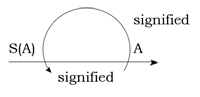
As you know, for a long time Lacan located the relation of the signifier to the signified on the basis of this schema. The horizontal line is the signifier and the retroactive vector is the signified, which entails that notwithstanding any signifying intention emerging from the bottom right, the signification effect depends on this place of the Other. This dependency is supposed to be evidenced in a particularly obvious manner by a number of psychotic phenomena and all the xenopathic effects which the subject can fall prey to. The Other is then introduced into the Real to address messages to the subject. Even though I cannot summarize here the entire theory of voices as detailed in Lacan’s seminar, let us give an overview of it. There is a disturbance in the working of the schema in psychosis, such that when the signification effect should take place on the left-hand side (it is known what that is talking about), another effect takes place there (it is not known what that is talking about). It talks yet it is not known what about. Let us write it as follows:
So (A) <-- U
To indicate the enigmatic void in signification, we will write So. Actually, according to this schema, it must depend on something that takes place at the level of the Other. Let us suppose that this enigmatic void in signification is the way in which the forclusion of the Name-of-the-Father appears semantically to the subject, as well as – why not? – when in the place of the Other there arises the function – which I already mentioned last time – of the One-father in the Real, that is, of what is covered by the semblance of the Name-of-the-Father. When the One appears in the place of the Other, we will write it as U. If we have this effect which we have called the enigmatic void in signification, instead of writing So (A), we will write. So (U):
So (U) <-- U
Here is, moreover, phallic signification, which is what is always involved, as Freud proved, in any normal signification effect; whereas what is inscribed on the level of the Other is, in its place, the Name-of-the-Father.

Its relation to the enigmatic void in signification prevents us from grasping that, after all, when there is no forclusion of the Name-of-the-Father, there is a relation to phallic signification. Every time something is understood, one stands in a relation to phallic signification, and depends on the inscription of the Name-of-the-Father in the place of the Other. Should there be, on the contrary, a One-father in the place of the Other, a special signification arises which Lacan calls an enigmatic void, that consists in not knowing what is meant, and is located at the moment of the crossing in the triggering and even, sporadically, at different points in the course of a psychosis.
Lacan then points out that in the enigmatic void of signification, there is an indeterminacy of this signification: the subject does not know what a number of signs addressed to him or her by the world mean; but at the same time, and in a manner proportional to that void, the subject has nonetheless the certainty that they mean something. There is a void in signification as regards contents, but there is the signification of signification. From this point of view, this is the deviant analogue of the psychoanalytic act, at least as regards this inscription of indeterminacy as certainty. And here we can give the difference between void and indeterminacy its full value.
Indeed, a supplementary element – which perhaps is here a sign proper to the register of psychosis – is that this would be less an indeterminacy than a void. And that is precisely what we may obtain from this year’s research in the Clinical Section lectures: an accurate clinic of these moments that are called intuitive phenomena. In order to do so, we must see how they were observed in the literature of classic psychiatry (and at this point we must acknowledge that there was an exquisite precision that already lent itself to many constructions), and determine the modalities of this clinic – and not of the entire view – in detail, as there is a difference between void, indeterminacy, and a number of other modalities.
And here Schreber’s sentence, which he highlighted and which Lacan mentions in page 479 of “On a Question Prior”, acquires its full value: “Aller Unsinn hebt sich auf!”
“All Nonsense cancels itself out!” It is, as he pointed out, something relative to this functioning, which he calls a special mode of Aufhebung of the Unsinn proper to psychosis, where Lacan recognizes the very law of the signifier. But why is it the very law of the signifier, and yet at the same time, what characterizes psychosis? “All Nonsense cancels itself out,” means precisely that everything has a sense, and that is what follows from this signification of signification when certainty is extended, if you will, to the subject’s entire perceptum: Umwelt and Innenwelt pass into each other, and then, indeed, everything has a sense!
This is the ideal, above all the ideal of Logical Positivism, Wittgenstein’s ideal for whom as Lacan suggests in The Reverse of Psychoanalysis, the diagnosis of psychosis would be particularly appropriate. The Logical Positivist ideal is precisely to create a language which makes the formulation of nonsense impossible. If we follow Lacan, Wittgenstein realized his psychosis by means of mathematical logic, or, put otherwise, mathematical logic is the continuation of psychosis by other means. From this point of view, we should point out that a language in which everything has a sense is nonetheless a language without metaphor inasmuch as metaphor plays precisely on nonsense. And along this line, the characterization of psychosis by the failure of the paternal metaphor can be seen in the remarkable absence of metaphor in Schreber’s discourse itself.
Thus one might think that psychoanalysis is a form of psychosis. It is possible – and Lacan said so from the very start – that psychoanalysis is a sort of directed paranoia, that is, an artificial relationship where everything has a sense. At this point, Lacan’s warning acquires its full value: if the Oedipus complex is withdrawn from psychoanalysis, one falls into Schreber’s delusion.
Freud found the metaphor of the Name-of-the-Father in the resources of tradition, precisely, in order to prevent psychoanalysis from turning into psychosis. But when he arrived to that point, Lacan was never content with the Oedipus complex and always thought of going beyond… There are many who believe that beyond the Oedipus complex lies some dark region to which bleating idiots would be led by evil pipers. Not at all. This region beyond the Oedipus complex is the most constant orientation in Lacan’s teaching, most particularly when, instead of Freud’s appeal to the Jewish tradition, Lacan tried to establish the theory of the mistake by the subject supposed to know. Nonetheless, this is doubtlessly not enough: there is also the theory of the analytic act, which for Lacan also lies beyond the Oedipus complex. This theory – which Freud was unable to develop because his resorting to the Name-of-the-Father blocked his way – makes it possible to re-establish without resorting to the Name-of-the-Father, the existence of nonsense, the existence of a knowledge belonging to no subject, which is sometimes, and rightly, called truth.
4th December 1991