The Semiotics of Schreber's Memoirs: Sign, Sinthome and Play
|
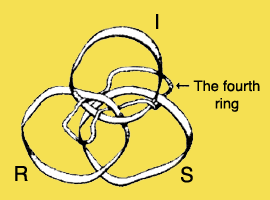
This article proceeds directly from "Lacan and Origami: A Three-Tiered Approach to Psychosis." In that article, I develop a theory of psychosis that takes a specifically topographical and semiotic approach to Schreber's Memoirs. One of the central postulates–the third tier–is that upon the semiotic collision1 with the 'rent'2 or 'abyss' in place of the foreclosed signifier (the signifier of the Name-of-the-Father), the signifying structure of the latent psychotic shatters, and the connection to the Øther3 (as barred Other) breaks. To the extent that the link with the Øther is severed, there are no 'real' others; only 'fleeting-improvised-men,' or evanescent elements of Schreber's shattered signifying structure.4 With Schreber's signifying structure quite literally in pieces, there is no longer a master signifier, a point de capiton to 'secure' his position in the world (existentially speaking). As such, he occupies various places (various identities) via the continual recombination (the glissement) of these signifying fragments.5 Insofar as there is nothing to 'hold the world in place,' Schreber and his 'universe' continually shift in a kaleidoscopic manner. Moreover, as I argue in "Lacan and
Origami,", to the extent that his signifying structure shatters, where his signifying elements (or clusters) exist as orphaned fragments, they can be reconnected with almost limitless variation. 'Almost,' because again in Schreber's case (and as I will argue), the semiotic architecture of his delusional 'reconstruction' is largely dependent upon the relation between the foreclosed signifier and its substitute. |
 |
|
[Figure 1: The Sinthome]7 |
|
Science and the Law: Schreber's Illegitimacy Insofar as science exists in a dichotomous relation to religion, i.e., it is what religion is not (i.e., religion is based upon 'faith,' whereas science bases itself on 'empirical fact'), science is particularly well suited to this task. Furthermore, as a dominant discourse, science is governed by a definiteset of laws based on logic and rationality. In other words, science brings order to chaos. In a semiotic 'universe' that is quite literally predicated upon nothing, the 'structuring' capacity of science cannot be underestimated. However, when science does eventually prove inadequate, when Flechsig (as a man of science) proves incapable of curing Schreber's 'nervous condition,' this semiotic distance collapses. This point is essential in determining the specific nature of Schreber's (second) psychotic break. The argument in general circulation is that in assuming the position of Senatspräsident to the Superior Court, Schreber is confronted with men who are in superior positions, and as such represent the father. Thus, try as he may, Schreber can not approximate this position; he found himself lacking (which was subsequently turned into a God that was lacking). Put another way, Schreber is called upon by the Law to a position for which he has no answer.
However, if we closely examine the Memoirs, it becomes clear that it is not Schreber's inability to carry out the tasks required of him, but rather, it is when (in his own words), he "had largely mastered the difficulties of settling down in [his] new office and in [his] new residence" (Memoirs, MH 63-64, D 47) that he experiences his (second) break. In other words, it is not that Schreber is 'in over his head.' Rather, because the signifier of the Name-of-the-Father (as that which functions as a 'third term' and as such secures his place and his continuity in a overriding kinship structure), is not available to Schreber because it is foreclosed, there is no legitimate place for him in the Law8. Thus it is in illegitimately (albeit 'successfully') occupying the place of Senatspräsident to the Superior Court–the realm of Law–that triggers Schreber's psychotic break.
'Soul murder' becomes the loss of one's name, or more specifically, the loss of one's legitimate place, one's right to exist as a subject of the Law. To the extent that the Symbolic Order–the overarching structure governing kinship relations– establishes one's legitimacy, one's right to exist and be recognized as a subject of the Law, such a loss would constitute 'soul murder.' Insofar as Flechsig specializes in nerves, Schreber (paranoically) believes that by acting upon his nerves11, Flechsig 'steals' his soul. (Memoirs, 54-55, D 33) In this capacity, Flechsig (as a signifier) plays leading role in Schreber's delusion.
This 'push and pull' dynamic is characteristic of the Imaginary realm; in fact, it could be argued that the Imaginary realm is particularly well suited for this reconstruction, i.e., because it involves rivalry, it incites Schreber to action, to actively (even if it is undertaken passively) reconstruct his signifying structure. Schreber asserts as an axiom that "the human soul is contained in the nerves of the body." (Memoirs, MH 45, D 19, emphasis mine). This sentence attests to another key feature of psychotic language, i.e., literalization. The 'literalization' of Schreber's signifying structure occurs both on a macro- (universal) and a micro-level. For example, Flechsig's soul is 'thrown' into Schreber's belly where it manifests as a 'bulky bundle' that Schreber compares with a "volume of wadding or cobweb" (Memoirs, MH 92, D 86). In both cases, i.e., macro (the universe) and micro (Flechsig), these elements are depicted as a web or a sort of network. However, in the latter case (Flechsig's soul), it is as though it is compressed. It is worth noting at this point that Schreber explicitly states that he had a vision where Flechsig shot himself, which was followed by a funeral procession. At this time (and in close proximity in the Memoirs), Schreber felt that Flechsig had exceeded himself, e.g., referring to himself as "God Flechsig" (Memoirs, MH 91, D 86), and that he should be reduced to size. Flechsig, as such, is compressed into a ball and subsumed in Schreber's belly (where Schreber could not 'stomach him'); as Schreber states, "[i]n view of its size it would in any case probably have been impossible to retain this soul in my belly, to digest it so to speak" (Memoirs, MH 92, D 86). As another case in point of this psychotic literalization, when the 'souls' renounce the implications of Schreber's corporeality– specifically his need for, and enjoyment of food–Schreber (literally, albeit delusionally) exists without a stomach.
As a final case in point, this 'literalization' is evidenced in Schreber's delusional belief that the contents of his head and his spinal cord were being "pumped out...in the form of little clouds," i.e., (like a 'puff of smoke') where they might "vanish into [thin] air" in order to make him demented (Memoirs, MH 135, D 147). When we situate these delusional manifestations in semiotic terms, abstractions are reduced to the concrete; connotations are reduced to denotations, and various denotations themselves are collapsed into a concrete singular meaning (nerves, or their manifestation as [divine] rays are the exemplar of this phenomenon). Schreber makes this explicit in the following passage:
This passage attests to another key feature of Schreber's delusion, i.e., while Schreber claims that rays must create, this creation is in fact a transformation of that which already exists. "They [the rays] have in particular the faculty of transforming themselves into all things of the created world; in this capacity they are called rays; and herein lies the essence of divine creation" (Memoirs, MH 46, D 21, emphasis mine). Schreber thus asserts that "great changeability is a marked feature of the soul-character" (Memoirs, MH 134, D 144). Insofar as Schreber is "filled with nerves of voluptuousness from the top of [his] head to the soles of [his] feet" (Memoirs, MH 204, D 243, emphasis mine) and "great changeability is a marked feature of the soul-character" (Memoirs, MH 134, D 144), the massive influx of rays (manifesting as 'nerves'), transforms Schreber into a voluptuous (i.e., nerve-filled), female being. Put another way, despite the manifestation of Schreber's delusion to create a new world (or to be the instrument of this creation), to the extent that Schreber no longer has access to the Øther, he cannot create, i.e., bring forth something new; rather, he can only transform, or in semiotic terms, reconnect and reorganize his disconnected signifying elements.
This reduction of abstractions to the concrete–this literalization–is particularly striking in what Schreber refers to as 'nerve language,' i.e., nerves as literalized souls (or rays) 'speak' in a manner consisting in the vibration of nerves approximating the movement of vocal chords (Memoirs, MH 69, D 54). In other words, language (arguably the exemplar of abstraction) is reduced to concrete action. Moreover, Schreber conflates his 'nervous illness' (generally understood as a state of mind, i.e., an abstraction) with the excitability of his physical nerves. In a very definite sense then, these two disparate denotations (not to mention connotations) are collapsed into the concrete. And we are not simply dealing with Schreber's physical nerves; rather all 'souls' in Schreber's 'universe' exist as literalized nerves (or rays). Having said this, however, to the extent Schreber exists within a closed Imaginary circuit, this semiotic collapse manifests as a literal proliferation, i.e., the only others (souls) Schreber encounters are himself, i.e., his own small others, or unbarred, perverse, status-seeking big Others. In this world turned inside-out, rather than securing the universe, 'God,' as an inept master signifier, continually loses his nerve(s)22 and as such, cannot 'ground' the universe; nor can He contain his nerve, i.e.,"[a]s a rule God did not interfere directly in the fate of peoples or individuals." Schreber designates this "state of affairs [as] in accordance with the Order of the World" (Memoirs, MH 48, D 23).
While Schreber does insert himself as the master signifier par excellance, he does not, and cannot (given his closed Imaginary circuit) introduce the quality of negation characteristic of radical Øtherness. Instead, he must continually negate himself by 'sacrificing' to a greater good. However, to the extent that he must to do this incessantly, it becomes more of a 'habit'–a necessary nuisance. Thus as counter-intuitive as it may sound, it is in the very act of negating himself, i.e., 'absorbing' or 'soaking up' rays, that Schreber regains himself (albeit as a literal 'bundle of nerves'). Now Schreber contends that when conditions are in accordance with the Order of the world, 'God' deals only with 'dead' nerves, i.e., by incorporating (or reincorporating) the nerves of corpses into Himself. Schreber further contends that "the nerves of living human beings particularly when in a state of high-grade excitation, have such power of attraction for the nerves of God that He would not be able to free Himself from them again, and would thus endanger His own existence" (Memoirs, MH 48, D 24, emphasis mine). In other words, 'God' was (necessarily) self-sufficient; He didn't need to approach the living human being, just as living human being didn't need to approach 'God.' (Here we get a glimpse of Schreber's pre-psychotic 'distance' from 'God' and religion.) Before Schreber's psychotic break, this distance manifests as a sort of disinterest in religion, i.e., he was not averse to it, yet not inclined toward it either.
From this passage, it is clear that 'God' (or religion) did not and could not function as the master signifier par excellance. However, while 'God' is not a grounding master signifier for Schreber, 'God' (or religion) represents the symbolic legacy of Schreber's father. Thus when Schreber confronts the rent in his signifying structure, insofar as his father's symbolic legacy is religion–a legacy and/or grounding signifier Schreber rejects (or forecloses)–he encounters a void in the place of 'God26.' As such, Schreber is compelled to insert 'God'/ religion into his signifying structure. However, to the very extent that religion was inadequate as a master signifier prior to Schreber's psychotic break, it remains inadequate even as it is inserted with certainty.
While as the above passage demonstrates, Schreber adheres to the scientific method, i.e., science appears to be the means by which Schreber measures Truth, this 'appearance' is deceiving. As the master signifier in a closed circuit, Schreber's truth literally 'consists32' in and of himself. Others exist only to the extent that they recognize (and concur) with his truth(s). If not, Schreber dismisses them as 'fleeting-improvised men' (Memoirs, footnote 19). Thus, if medical science does not concur with Schreber, then medical science is wrong. If the authorities do not arrive at the same conclusion as Schreber, then the authorities are wrong (if indeed they exist at all). The point here is that insofar as Schreber positions himself as the measure of Truth (or rather, truth), the very nature of his delusional 'reconstruction' precludes the possibility of its ultimate success. Put another way, while Schreber's existence progressively becomes more tolerable, and his symptoms subside, he still retains the belief that he is the center of the 'universe.' To the extent that Schreber is a literalized discourse unto himself, a discourse where he functions as the master signifier par excellance, the Øther does not penetrate Schreber (i.e., despite its manifestation, his delusion is 'assembled' within an entirely closed circuit). At best, Schreber exists 'alongside' the Øther.
While initially this passage may appear as simply another inexplicable delusional manifestation, when read analytically, it becomes evident that it is both in keeping with psychotic literalization, i.e., 'souls' as Schreber's small others (which manifest as literal nerves)–another example of the interweaving of religious and scientific terms, i.e., 'souls' (religious), and 'nerves' (scientific)–and the closed linguistic circuit they inhabit. As such, 'souls' have only existing signifiers at their disposal; this manifests as their 'pleasure in reveling in the past,' and their inability to retain new impressions (Memoirs, MH 52, D 28). To reiterate, insofar as the 'Schreberian universe' is closed, the only (divine) penetration Schreber experiences is the reincorporation of his own signifying structure. As such, Schreber's relation to 'God' is entirely 'masturbatory.' (As an aside, given Moritz Schreber's rigorous interdiction against masturbation, the relation between Schreber and 'God' would most definitely constitute conditions contrary to the Order of the World35.) |
 |
|
[Figure 2: The 'Schreberian Universe'] |
|
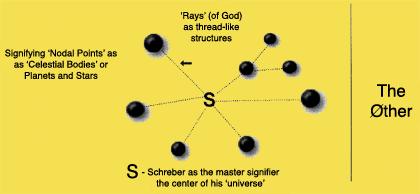
In the Imaginary, rivalrous dimension, this unification manifests as a battle; specifically one that would prevent rays and souls from entering Schreber's body. These practices include "the system of writing down, not-finishing-a-sentence [and] tying-to-celestial bodies" (Memoirs, MH 198, D 235). In theoretical terms, these practices are the means of preventing a semiotic implosion. In Schreber's delusion, this manifests as souls being drawn directly into his body (Memoirs, MH 228-229, D 276). To further elucidate this point, if we accept as a postulate that relations of difference (which implicitly require distance) is the 'means' of 'meaning-making,' then it is imperative that these 'celestial bodies,' i.e., nodal points in Schreber's disconnected, and externalized signifying structure, are 'fixed' in place. Keep in mind, though that despite appearances this battle is played out within Schreber's closed Imaginary circuit. Thus while these practices appear to facilitate distance from Schreber, in actuality, they facilitate distance (and by extension, relations of difference) within Schreber's signifying structure. Put another way, the system of writing-down, not-finishing-a-sentence, and tying-to-celestial-bodies 'solidifies' Schreber nascent signifying structure. As the literalized, psychotic manifestation of a point de capiton, they stop the constant sliding (glissement) of signifiers.
While the "writing-down-system"39 does appear to be the means by which Schreber 'solidifies' his signifying structure (particularly given that the writing-down-system coincided with the practice of tying-to-celestial-bodies), it also evidences the 'closed' nature of this system, i.e., it is based on the (delusional) premise that thought is finite; hence the oft-repeated statement, "we have already got this" (Memoirs, MH 122, D 128), or "has been recorded" (Memoirs, MH 187-188, D 220).
On a semiotic level, the 'interrupted sentences' described in the above passages are disrupted both on a paradigmatic and syntagmatic level. It is not just that meaning is not obtained because diachronically speaking, the sentence does not end, but that there is also a profound disturbance in the structure or system itself. It is not simply that Schreber cannot finish his sentences, but rather, he must make 'meaning' by connecting signifying fragments (via juxtaposition). Granted, these sentences are rather ill-conceived, but given the nature of his task–that of reconnecting disconnected signifying elements–this is to be expected. Put another way, the grammatically incomplete sentences (as signifying fragments) prompt Schreber to make connections, i.e., by finishing the sentences, he is pinning (or perhaps 'tying'41) these otherwise free-floating signifying elements. |
 |
|
[Figure 3: Schreberian Signifying Structure] |
|
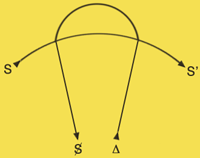
In the "Subversion of the subject and the dialectic of desire" (Graph I, the elementary cell of desire), Lacan illustrates how an 'anchoring point' (point de capiton) stops (or 'pins') the otherwise endless movement (glissement) of signification" (Lacan, Écrits, 303). Understood from this perspective, these 'subordinate' signifying elements only have 'meaning' in relation to a master signifier. The relation, as such, is syntagmatic, i.e., as in a sentence, these signifying elements only achieve their signifying function to the extent that they refer back to a master signifier (whether it be Zoroastrianism [Ariman and Ormuzd], or more commonly, democracy, communism, etc.)
|
 |
|
[Figure 4: Graph of Desire Elementary Cell] |
|
Zizek provides an insightful elucidation of this process. In The Sublime Object of Ideology, he indicates that
The implications are: 1) that signifying elements only have meaning in relation to other signifying elements (i.e., through difference); 2) 'meaning' is always and only established retroactively; and 3) that the master signifier is not simply a particularly dense nodal point, but rather, its role is entirely structural, and in and of itself, signifies nothing. If we conceptualize a system of differences, where meaning is not located in the signifier per se, but in its relation to other signifiers, this raises the question of whether a master signifier occupies a privileged status.
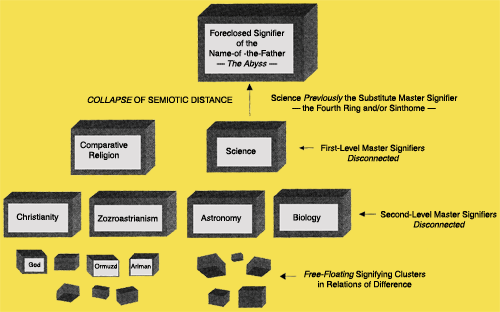
While from both a Derridean and Saussurean perspective, all signifiers would be considered equal (to the extent they acquire meaning through relations of difference), I suggest that we envision a linguistic structure within a hierarchal framework44. I propose a theoretical approach that utilizes both the concept of a master signifier, and a system of difference, i.e., where a master signifier 'pins' relations of difference as signifying clusters. If we accept as a postulate that meaning is established via difference, and use a kaleidoscope as an analogy–where signifiers, like colored pieces of glass, shift in an endless variety of patterns–to the extent that the 'kaleidoscope' shifts, these signifying elements should assume entirely different meanings. This however, is not the case with Schreber. While the relation of master signifiers to the master signifier par excellance is severed, as are the relations between (subordinate) master signifiers, as Figure 3 (the Schreberian signifying structure) illustrates, the signifying clusters subsumed 'beneath' these severed master signifiers are retained. They are, as Schreber describes them, "like stars from which nerves hang suspended beneath them" (Memoirs, MH 84, 94, D 75, 90).
It is here that a semiotic analysis of the Memoirs–an analysis that examines both the construction and disintegration of meaning in relation to difference, and does so within a hierarchical framework, i.e., signifiers that refer (or defer) to master signifiers–becomes increasingly complex. The semiotic 'reorganization' of Zoroastrianism is a case in point45. As a (second-level) master signifier, Zoroastrianism is clearly part of Schreber's signifying structure (Schreber is a very educated and well-read man). Early in his psychotic break, the 'subsumed' signifying cluster (which includes the elements 'Ariman' and 'Ormuzd') is detached from its master signifier (Zoroastrianism), a master signifier that after Schreber's (second) psychotic break, quite literally refers to nothing, i.e., as Figure 3 illustrates, the (first-level) master signifier 'Comparative Religion' refers to 'the abyss.' To the extent that 'Comparative Religion' refers to nothing–an abyss in the place of the signifier of the Name-of-the-Father–it becomes meaningless. In this way, Ariman and Ormuzd become elements of a 'free-floating' signifying cluster. However, it is important to keep in mind that as a signifying cluster, i.e., as signifiers existing in relations of difference, these signifying elements maintain some of their meaning. Thus Ariman and Ormuzd continue to exist as opposing forces. Moreover, their 'battle' is fought out in terms of cosmogony and eschatology–key elements of Zoroastrianism. Of particular interest however (although this is not depicted in Figure 3), is that Ariman and Ormuzd are repositioned (and 'pinned') by a 'quasi-Christian' deity, i.e., another master signifier–and, not incidentally, one that is 'dependent' upon Schreber.
Now as I've discussed, Schreber's 'universe' starts to 'rot' (or decay) when it is exposed as based upon nothing. Schreber thus envisions himself as a leper who "inters other lepers/corpses [in order] to provide for themselves an at least tolerable death" (Memoirs, MH 98, D 94). In semiotic terms, this 'plague' evidences both the literal decay of Schreber's signifying structure, and a means through which he engages in its reconstruction, i.e., 'purifying' nerves through his body is yet another means of reincorporating (and reorganizing) disconnected signifying elements. Schreber's task, as such, is not only to reconnect the 'universe,' but through his transformative, nerve-filled body, to purify its decayed nerves (Memoirs, MH 72-73, D 59). Rot and purification–key elements of Zoroastrianism–can also be discerned in what Schreber refers to as 'putrid matter.' Specifically, Schreber contends that "day after day and hour after hour, poison of corpses and other putrid matter which the rays carried was heaped upon [his] body, in the belief that it would be possible in this way to suffocate [him] eventually and in particular to rob [him] of [his] reason" (Memoirs, MH 120, D 126). Of particular interest however, is Schreber's association of this 'rottenness' with the practice of 'tying-to-celestial bodies,' i.e., a means of reconnecting his disconnected signifying structure.
Based upon this analysis thus far, it can be argued that these incessantly repeated, yet meaningless (disconnected) signifiers are the (literalized) 'refuse' of Schreber's semiotic reconstruction. Allow me to elaborate this point. To the extent that this 'putrid matter' is caught within a closed circuit, there is no exit; hence it continually reappears as nonsense. Put another way, 'putrid matter' is the 'debris,' so to speak, of the signifiers and signifying clusters that Schreber uses to reconstruct his 'universe.' In other words, because these signifying clusters are incorporated in (very) different ways, there is always a surplus. In banal terms, to the extent that Schreber's 'universe' is confined to himself, there is no place to 'dump the garbage.' Thus the putrid matter–signifying refuse–is 'dumped' on Schreber and in particular, his nerves (Memoirs, MH 98, 120, 135, 156; D 95, 126, 146, 175). Supporting this argument, Schreber explicitly refers to 'putrid matter' as "the remnants [that have been detached from] the forecourts of heaven" (Memoirs, MH 124, 121; D 190, 196). Schreber's Pregnancy: A 'Body' of Signifiers
At this point I would like to shift this analysis to another very interesting 'development,' i.e., Schreber's transsexualism. In the Memoirs, Schreber states categorically that creation is "creation out of the void " (Memoirs, MH 42, D 16-17, emphasis mine); though at the same time, he asserts that this is beyond human understanding–and importantly, that it is contrary to scientific beliefs (Memoirs, MH 42, D 16-17, emphasis mine). Yet if Schreber's breakdown is a semiotic confrontation with an abyss rather than a grounding signifier (the signifier of the Name-of-the-Father), then his 'creation' is precisely a creation (or rather 'transformation') out of the void. And Schreber himself must (literally) fill this void by reconciling these disparate discourses through a 'union of all rays,' a union, that in this concretized universe can only occur via the 'voluptuous' of his nerve-filled body. To the extent that Schreber equates nerves with femininity, his transformation into a woman, i.e., becoming full of nerves46, is essential in his endeavor to establish himself as the master signifier.
It has also been argued that the devices of constraint devised by Schreber's father (and tested on his sons) 'predisposed' Schreber to a passive 'feminized' position, or eroticized the passive position. Lacan, on the other hand, takes a structuralapproach and argues that Schreber's 'transsexualism' is the result of the lack of the signifier of the Name-of-the-Father, i.e., since there is no paternal signifier to 'ground' Schreber, he 'regresses' to the feminine. While I do agree with Lacan that it is the lack of the signifier of the Name-of-the-Father that incites Schreber's transformation into a woman, it is not for the same reason. It continues to be my argument that insofar as the signifier of the Name-of-the-Father is foreclosed, and that this radical lack is confronted and revealed as empty, the subordinate master signifiers refer to nothing. Furthermore insofar as the subordinate master signifiers refer to nothing, they themselves become unhinged and empty. Schreber's signifying structure is, as such, predicated upon nothing. Situating this in terms of kinship relations (another theme that pervades the Memoirs), without a 'semiotic progenitor,' Schreber is illegitimate, i.e., he has no 'place' in the Symbolic Order (the realm of Law). Now as I have argued throughout this analysis, Schreber does not (and cannot) create; however he does transform by reconnecting and reorganizing existing (though disconnected) signifiers. In this way, Schreber constructs a body of signfiers–though one with an entirely different shape. Pivotal to this line of argumentation is Schreber's 'conception' of nerves. In the 'Schreberian universe,' souls (both 'tested' and 'untested') and rays (of God) manifest as literalized nerves. Indeed, nerves are the very infrastructure of the 'Schreberian universe.' Thus Schreber asserts that nerves "develop to a complex system which embraces the most widespread regions of human knowledge" (Memoirs, MH 45, D 19, emphasis mine). With the totality of human knowledge literally residing in Schreber, i.e., with his body filled with nerves, Schreber is 'pregnant' with his own incipient signifying structure. While in his delusion this manifests as his divine calling to give birth to a new race, it is ultimately for Schreber to give birth to himself, i.e., to install himself as the master signifier par excellance. In his feminine and creative (or rather, transformative) capacity–his 'soul-voluptuousness' (Memoirs, MH 99, 120, 122, 145-146, 148, 150-151, 156, 165-168, 173, 175-178, 186, 189, 193, 199, 201-202, 209-210, 214, 221, 223, 225, 228-229, 231, 235, 237-240, 252; D 128, 166-167)–Schreber fills the void in the 'universe' with his voluptuous body–a literalized, hybrid 'body of knowledge.' Now Schreber's body must have the capacity to facilitate these rays (imagine a foetus in a male body). To reiterate an important point, insofar as Schreber reconstructs a new 'universe' out of the fragments of his shattered signifying structure, he constructs a new S2. Understood from this perspective, Schreber's transformation into a woman is 'semiotically' coextensive with the process of reincorporating and reorganizing his disconnected signifying fragments, i.e., by incorporating 'nerves of voluptuousness.' Thus while the confrontation with the lack of the signifier of the Name-of-the-Father instigates Schreber's breakdown, his transformation into a woman is far more complex than what Lacan envisions (particularly from a semiotic perspective). Returning to Freud for a moment, his argument that Schreber becomes a female to facilitate sexual relations with a male (be it Flechsig or God), misses a crucial element of Schreber's delusion. Recall that Schreber feels compelled to envision himself as both a man and a woman engaged in sexual relations, "I have to imagine myself as a man and woman in one person having intercourse with myself" (Memoirs, MH 208, D 250). Put another way, Schreber's body must be the locus which facilitates the 'marriage' of opposing or different entities. Filled with nerves of God (nerves of voluptuousness) merged with science, Schreber facilitates a new order–one where the foreclosed signifier (religion or God) and its substitute (science) are reconciled in and through his nerve-filled (and as such, feminized) body. Understood in semiotic terms, the signifying elements (which Schreber envisions as "nerve endings") that "dissolve in [Schreber's] body" are 'pinned' by Schreber in his 'seminal' capacity as the master signifier par excellance (via tying-to-celestial-bodies, the practice of not-finishing-a-sentence, and the writing-down-system). The rather paradoxical situation that emerges, however, is that in restoring this universal balance, these 'souls' become part of Schreber's body; this results in an increase of "soul voluptuousness" (Memoirs, MH 83, D 74). Thus the more souls 'lose themselves' in Schreber, the more souls are attracted to him. As Schreber points out, "I always warned them against approaching me, since I had become aware of the immensely increased power of attraction of my nerves from what had happened earlier, but the souls could not at first believe that I had such a dangerous power of attraction" (Memoirs, MH 84, D 75). In this way, Schreber's 'soul voluptuousness' increases exponentially to the extent that he is ultimately greater than God. It is through this semiotic process of reincorporation, or establishing a structure where all signifying elements refer to him, that Schreber succeeds in establishing himself as the master signifier par excellance. Interestingly, this process parallels the way God (previously) renewed Himself through the reabsorption of souls (before conditions were contrary to the Order of the World). "It was ... the ultimate destiny of all souls to merge with other souls, and integrate into higher entities, remaining aware only of being part of God" (Memoirs, MH 52, D 29). To elaborate this point, under 'normal' circumstances, 'souls' (i.e., the physical remnants of dead human beings) 'lose themselves' in God through their reabsorption into His totality–a totality of physical, literalized nerves. However, with conditions contrary to the Order of the World, souls now 'lose themselves' in Schreber. Put another way, instead of divine renewal occurring through God, it now occurs through Schreber. This concerns Schreber and leads him to contemplate "[w]hat detailed measures God would have to adopt after my death I feel I can hardly as much as speculate on" (Memoirs, MH 213, D n/a). Schreber is not simply a rival–a dynamic facilitated by the Imaginary– but a substitute for God. "They [the souls] ... regain in my body a more or less adequate substitute for the lost heavenly Blessedness which itself consisted in enjoyment similar to voluptuousness" (Memoirs, MH 149-150, D 166). In short, Schreber–not God–becomes the grounding master signifier of the universe (albeit Schreber's own [unrecognizable] signifying structure). Furthering this line of argument, insofar as Schreber's incipient signifying structure re-enters his body, he prepares to give birth to a new order (as the 'voices' indicate "[a] new race of human beings from the spirit of Schreber") (Memoirs, MH 211, D n/a). Thus to the extent that Schreber increases in size–a semiotic 'pregnancy,' so to speak, the 'universe' decreases (Memoirs, MH 94-95, 196; D 90, 166). Unlike Zizek's 'entirely structural' master signifier, as the master signifier par excellance, Schreber is precisely and quite literally 'a particularly dense nodal point.' Moreover, as the signifying elements (or clusters) previously 'attached' to God are progressively 'soaked up' into Schreber, he becomes infallible. In other words, to the extent that religion–God–and science (as discourses) are progressively 'emptied,' truth (albeit lowercase) is quite literally located within Schreber. In his (literalized) delusion, this manifests as a physical increase in 'soul voluptuousness.' It is through Schreber's 'soul-voluptuousness,' or in semiotic terms, reincorporating and reorganizing his (previously) disconnected signifying elements, that Schreber believes he has become invulnerable. Thus he asserts with "absolute certainty...that God will never succeed in his purpose of destroying [his] reason" (Memoirs, MH 211, D 168). And that "[t]he scales of victory are coming down on [his] side more and more, the struggle against [him] continues to lose its previous hostile character, [and] the growing soul-voluptuousness makes [his] physical condition and [his] other outward circumstances more bearable" (Memoirs, MH 214, D n/a). This leads to a very interesting phenomena. As these 'external' discourses are progressively 'emptied' via their reincorporation into Schreber, phrases become increasinglymonotonous and grammatically incomplete, i.e., there is an inverse relation between the grammatical integrity of the external voices (souls and rays) and Schreber's reincorporation of his signifying 'universe.' Indeed, the 'voices' are eventually so indecipherable, that Schreber likens them to a hissing sound. (Memoirs, MH 202, D 241). Given the continual references to 'proximity' that pervade the Memoirs, it is hardly surprising that Schreber attributes this to the long distances these rays must now span due to the paucity of their vocabulary.
In other words, as Schreber's soul-voluptuousness increases, i.e., as he progressively reincorporates his signifying elements (manifesting as souls and nerves), there is a "great shortage of speech-material at the disposal of the rays [which have not already been reincorporated into Schreber] with which to bridge the vast distances separating the stars, where they are suspended, from [his] body" (Memoirs, MH 175, D 202). When situated within the perspective of 'nerve language,' the scarcity of words at the rays' disposal results in fewer 'vibrations.' Thus (and quite literally), as the rays are progressively 'absorbed' or 'soaked up' into Schreber, i.e., reincorporated into his signifying structure (where they are no longer experienced as external), they run out of words. At this point, Schreber has reincorporated most of his small others, his signifying fragments and clusters. However as I indicate above, he 'stitches' them together in a bizarre fashion (though one that 'works' for him). And in so doing, he inserts himself as the master signifier par excellance where everything refers to him (or as his delusion manifests, are 'attached' in and through his body). SUMMARY Writing his Memoirs is both a means for Schreber to 'solidify' his linguistic structure–the new S2–he constructs, and to incorporate it (or arguably, himself) into an over-arching structure. By inscribing it in writing (and publishing it), he situates his structure within the realm of society as a whole. Put another way, even though Schreber writes his Memoirs on the Imaginary plane, by publishing his work, his signifying structure circulates within the Symbolic. Indeed, it was Schreber's intent (and belief) that his new S2 be integrated into the existing body of knowledge. "I can only see a real purpose in my life if I succeed in putting forward the truth of my so-called delusions, so that other people will be convinced and mankind gain a truer insight into the nature of God" (Memoirs, MH 248, D 302). However, to the extent that his new signifying structure is constructed on the Imaginary plane in a closed circuit, his S2 is qualitatively different than the S2 of the Symbolic (at any given time). Specifically, while the normal/neurotic refers to the Øther to constitute (and confirm) his or her sense of reality, the psychotic, by contrast, refers to him- or herself. At a later point in Schreber's delusion, he once again recognizes the existence of 'real' people, and this causes him to question his previous views. Now keep in mind that these 'real' people have been there all along–he just was not able to recognize them. In other words, his signifying structure is now such that he can recognize other people. However– and this is important–he still retains the belief that there is a qualitative change in the world. And indeed, to the extent that 'the world' is his signifying structure, it has changed. To reiterate, once Schreber's signifying structure achieves a certain degree of ontological integrity or stability–once it begins to congeal–Schreber refers to the Law (the Øther) for his release. In a sense then, having re-established himself on the Imaginary plane (reconnecting his signifying structure), and in so doing being able to recognize himself as a human being "worthy of human dignity" (Memoirs, MH 201, D 238) and is able to recognize real others (not just his own small others). With his signifying structure now intact (though with a bizarre organization), he seeks a 'place' in the Symbolic Order proper. The question remains though: does his discourse (now) pass through the circuit of the Øther? or is the law he invokes and appeals to simply signifiers in his own closed circuit? As I emphasize throughout this analysis, while Schreber seeks validation from the Øther (in this case medical authorities), the measure of truth remains within himself–and it is a literal and corporeal truth, i.e., his body. What Schreber experiences as 'soul voluptuousness' is in fact a reconstructed 'body of signifiers.' Thus the 'meaning' of Schreber's delusion, the signifying structure he constructs (by juxtaposing existing signifying elements and/or clusters) physically manifests in and on his body. While Schreber may now recognize the existence of doctors (where earlier in his delusion, they were all fleeting-improvised men), the last word remains in his body (versus the abstract scientific body of knowledge). So there has been a change, i.e., Schreber does recognize the ontology of others, however the locus of truth is not in a universal–a shared cultural/societal S2–but rather, it remains in himself. Consequently, rather than obtaining a 'place' in the Symbolic Order proper, as I indicated earlier, Schreber can (at best), exist alongside the Øther. notes
1. As this analysis will demonstrate, the semiotic collision resembles a cosmological 'big bang' (on many levels). Briefly stated however, the collapse of the substitute discourse into the place of the foreclosed signifier constitutes an implosion. With the barrier breached, relations between signifiers shatter such that they become unrecognizable as one's own. This results in an explosion, or perhaps better put, an expulsion of seemingly external and foreign entities. However, as these signifiers are progressively reincorporated via psychotic delusion, the 'universe' ceases to expand and again starts to compress.
WORKS CITED Fink, Bruce, The Lacanian Subject: Between Language and Jouissance, (Princeton, New Jersey: Princeton University Press), 1995. Freud, Sigmund. "Psychoanalytic Notes on an Autobiographical Account of a Case of Paranoia(Dementia Paranoides) (Schreber)" (1911 [1910]), Case Histories II. Volume 9, Penguin/Freud Library, Eds. Angela Richards, Albert Dickson, trans. James Strachey. Lacan, Jacques, Écrits: A Selection. Trans. Alan Sheridan., (New York London: W.W. Norton & Company, 1977). Lacan, Jacques, The Seminar of Jacques Lacan: Book III, Ed. Jacques-Alain Miller, trans. Russell Grigg, (New York London: W.W. Norton & Company, 1988). Lacan, Jacques, The Seminar of Jacques Lacan: Book XXIII: The Sinthome, [draft translation by Luke Thurston.] Neiderland, William., The Schreber Case, (Hillsdale, N.J.: Analytic Press, 1984). Schatzman, Morton, Soul Murder, (New York: Random House, 1973). Schreber, Daniel Paul, Memoirs of My Nervous Illness, Eds. and Trans. Ida MacAlpine and Richard Hunter, (London: W. Dawson, 1955). Zizek, Slavoj, The Sublime Object of Ideology, (London, New York: Verso, 1989). |

|