Lenin's Choice: Interpretation vs. Formalization
The first public reaction to the idea of reactualizing Lenin is, of course, an outburst of sarcastic laughter: Marx is OK, even on Wall Street, there are people who love him today – Marx the poet of commodities, who provided perfect descriptions of the capitalist dynamics, Marx of the Cultural Studies, who portrayed the alienation and reification of our daily lives -, but Lenin, no, you can’t be serious! The working class movement, revolutionary Party, and similar zombie-concepts? Doesn’t Lenin stand precisely for the FAILURE to put Marxism into practice, for the big catastrophe which left its mark on the entire XXth century world politics, for the Real Socialist experiment which culminated in an economically inefficient dictatorship? So, in the contemporary academic politics, the idea to deal with Lenin is accompanied by two qualifications: yes, why not, we live in a liberal democracy, there is freedom of thought… however, one should treat Lenin in an “objective critical and scientific way,” not in an attitude of nostalgic idolatry, and, furthermore, from the perspective firmly rooted in the democratic political order, within the horizon of human rights – therein resides the lesson painfully learned through the experience of the XXth century totalitarianisms.
What are we to say to this? Again, the problem resides in the implicit qualifications which can be easily discerned by the “concrete analysis of the concrete situation,” as Lenin himself would have put it. “Fidelity to the democratic consensus” means the acceptance of the present liberal-parlamentary consensus, which precludes any serious questioning of how this liberal-democratic order is complicit in the phenomena it officially condemns, and, of course, any serious attempt to imagine a society whose socio-political order would be different. In short, it means: say and write whatever you want – on condition that what you do does not effectively question or disturb the predominant political consensus. So everything is allowed, solicited even, as a critical topic: the prospects of a global ecological catastrophe, violations of human rights, sexism, homophobia, antifeminism, the growing violence not only in the far-away countries, but also in our megalopolises, the gap between the First and the Third World, between the rich and the poor, the shattering impact of the digitalization of our daily lives… there is nothing easier today than to get international, state or corporate funds for a multidisciplinary research into how to fight the new forms of ethnic, religious or sexist violence. The problem is that all this occurs against the background of a fundamental Denkverbot, the prohibition to think. Today’s liberal-democratic hegemony is sustained by a kind of unwritten Denkverbot similar to the infamous Berufsverbot in Germany of the late 60s – the moment one shows a minimal sign of engaging in political projects that aim to seriously challenge the existing order, the answer is immediately: “Benevolent as it is, this will necessarily end in a new Gulag!” The ideological function of the constant reference to the holocaust, gulag and the more recent Third World catastrophes is thus to serve as the support of this Denkverbot by constantly reminding us how things may have been much worse: “Just look around and see for yourself what will happen if we follow your radical notions!” And it is exactly the same thing that the demand for “scientific objectivity” means: the moment one seriously questions the existing liberal consensus, one is accused of abandoning scientific objectivity for the outdated ideological positions. This is the point on which one cannot and should not concede: today, the actual freedom of thought means the freedom to question the predominant liberal-democratic “post-ideological” consensus – or it means nothing.
Habermas designated the present era as that of the neue Undurchsichtlichkeit – the new opacity. [1] More than ever, our daily experience is mystifying: modernization generates new obscurantisms, the reduction of freedom is presented to us as the arrival of new freedoms. In these circumstances, one should be especially careful not to confuse the ruling ideology with ideology which SEEMS to dominate. More then ever, one should bear in mind Walter Benjamin’s reminder that it is not enough to ask how a certain theory (or art) declares itself to stay with regard to social struggles – one should also ask how it effectively functions IN these very struggles. In sex, the effectively hegemonic attitude is not patriarchal repression, but free promiscuity; in art, provocations in the style of the notorious “Sensation” exhibitions ARE the norm, the example of the art fully integrated into the establishment.
One is therefore tempted to turn around Marx’s thesis 11: the first task today is precisely NOT to succumb to the temptation to act, to directly intervene and change things (which inevitably ends in a cul de sac of debilitating impossibility: “what can one do against the global capital?”), but to question the hegemonic ideological coordinates. If, today, one follows a direct call to act, this act will not be performed in an empty space – it will be an act WITHIN the hegemonic ideological coordinates: those who “really want to do something to help people” get involved in (undoubtedly honorable) exploits like Medecins sans frontiere, Greenpeace, feminist and anti-racist campaigns, which are all not only tolerated, but even supported by the media, even if they seemingly enter the economic territory (say, denouncing and boycotting companies which do not respect ecological conditions or which use child labor) – they are tolerated and supported as long as they do not get too close to a certain limit. This kind of activity provides the perfect example of interpassivity: [2] of doing things not to achieve something, but to PREVENT from something really happening, really changing. All the frenetic humanitarian, politically correct, etc., activity fits the formula of “Let’s go on changing something all the time so that, globally, things will remain the same!”
Let us take two predominant topics of today’s American radical academia: postcolonial and queer (gay) studies. The problem of postcolonialism is undoubtedly crucial; however, “postcolonial studies” tend to translate it into the multiculturalist problematic of the colonized minorities’ “right to narrate” their victimizing experience, of the power mechanisms which repress “otherness,” so that, at the end of the day, we learn that the root of the postcolonial exploitation is our intolerance towards the Other, and, furthermore, that this intolerance itself is rooted in our intolerance towards the “Stranger in Ourselves,” in our inability to confront what we repressed in and of ourselves – the politico-economic struggle is thus imperceptibly transformed into a pseudo-psychoanalytic drama of the subject unable to confront its inner traumas… The true corruption of the American academia is not primarily financial, it is not only that they are able to buy many European critical intellectuals (myself included – up to a point), but conceptual: notions of the “European” critical theory are imperceptibly translated into the benign universe of the Cultural Studies chic.
My personal experience is that practically all of the “radical” academics silently count on the long-term stability of the American capitalist model, with the secure tenured position as their ultimate professional goal (a surprising number of them even play on the stock market). If there is a thing they are genuinely horrified of, it is a radical shattering of the (relatively) safe life environment of the “symbolic classes” in the developed Western societies. Their excessive Politically Correct zeal when dealing with sexism, racism, Third World sweatshops, etc., is thus ultimately a defense against their own innermost identification, a kind of compulsive ritual whose hidden logic is: “Let’s talk as much as possible about the necessity of a radical change to make it sure that nothing will really change!” Symptomatic is here the journal October: when you ask one of the editors to what the title refers, they will half-confidentially signal that it is, of course, THAT October – in this way, one can indulge in the jargonistic analyses of the modern art, with the hidden assurance that one is somehow retaining the link with the radical revolutionary past… With regard to this radical chic, the first gesture towards the Third Way ideologists and practitioners should be that of praise: they at least play their game in a straight way, and are honest in their acceptance of the global capitalist coordinates, in contrast to the pseudo-radical academic Leftists who adopt towards the Third Way the attitude of utter disdain, while their own radicality ultimately amounts to an empty gesture which obliges no one to anything determinate.
It is true that, today, it is the radical populist Right which is usually breaking the (still) predominant liberal-democratic consensus, gradually rendering acceptable the hitherto excluded topics (the partial justification of Fascism, the need to constrain abstract citizenship on behalf of ethnic identity, etc.). However, the hegemonic liberal democracy is using this fact to blackmail the Left radicals: “we shouldn’t play with fire: against the new Rightist onslaught, one should more than ever insist on the democratic consensus – any criticism of it willingly or unwillingly helps the new Right!” This is the key line of separation: one should reject this blackmail, taking the risk of disturbing the liberal consensus, up to questioning the very notion of democracy.
So how are we to respond to the eternal dilemma of the radical Left: should one strategical support center-Left figures like Bill Clinton against the conservatives, or should one adopt the stance of “it doesn’t matter, we shouldn’t get involved in these fights – in a way, it is even better if the Right is directly in power, since, in this way, it will be easier for the people to see the truth of the situation”? The answer is the variation of old Stalin’s answer to the question “Which deviation is worse, the Rightist or the Leftist one?”: THEY ARE BOTH WORSE. What one should do is to adopt the stance of the proper dialectical paradox: in principle, of course, one should be indifferent towards the struggle between the liberal and conservative pole of today’s official politics – however, one can only afford to be indifferent if the liberal option is in power. Otherwise, the price to be paid may appear much too high – recall the catastrophic consequences of the decision of the German Communist Party in the early 30s NOT to focus on the struggle against the Nazis, with the justification that the Nazi dictatorship is the last desperate stage of the capitalist domination, which will open eyes to the working class, shattering their belief in the “bourgeois” democratic institutions. Along these lines, Claude Lefort himself, whom no one can accuse of communist sympathies, recently made a crucial point in his answer to Francois Furet: today’s liberal consensus is the result of 150 years of the Leftist workers’ struggle and pressure upon the State, it incorporated demands which were 100 or even less years ago dismissed by liberals as horror. [3] As a proof, one should just look at the list of the demands at the end of The Communist Manifesto: apart from 2 or 3 of them (which, of course, are the key one), all others are today part of the consensus (at least the disintegrating Welfare State one): the universal vote, the right to free education, universal healthcare and care for the retired, limitation of child labor…
Interpretation versus Formalization
So where are we to begin? In the present climate of the New Age obscurantism, it may appear attractive to reassert the lesson of Lenin’s Materialism and Empiriocriticism: in today’s popular reading of quantum physics, as in Lenin’s times, the doxa is that science itself finally overcame materialism – matter is supposed to “disappear,” to dissolve in the immaterial waves of energy fields. [4] It is also true (as Lucio Colletti emphasized), that Lenin’s distinction between the philosophical and the scientific notion of matter, according to which, since the philosophical notion of matter as reality existing independently of mind precludes any intervention of philosophy into sciences, the very notion of “dialectics in/of nature” is thoroughly undermined. However… the “however” concerns the fact that, in Materialism and Empiriocriticism, there is NO PLACE FOR DIALECTICS, FOR HEGEL. What are Lenin’s basic theses? The rejection to reduce knowledge to phenomenalist or pragmatic instrumentalism (i.e., the assertion that, in scientific knowledge, we get to know the way things exist independently of our minds – the infamous “theory of reflection”), coupled with the insistence of the precarious nature of our knowledge (which is always limited, relative, and “reflects” external reality only in the infinite process of approximation). Does this not sound familiar? Is this, in the Anglo-Saxon tradition of analytical philosophy, not the basic position of Karl Popper, the archetypal anti-Hegelian? In his short article “Lenin and Popper,” [5] Colletti recalls how, in a private letter from 1970, first published in Die Zeit, Popper effectively wrote: “Lenin’s book on empiriocriticism is, in my opinion, truly excellent.” [6]
This hard materialist core of Empiriocriticism persists in the Philosophical Note-Books from 1915, in spite of Lenin’s rediscovery of Hegel – why? In his Note-Books, Lenin is struggling with the same problem as Adorno in his “negative dialectics”: how to combine Hegel’s legacy of the critique of every immediacy, of the subjective mediation of all given objectivity, with the minimum of materialism that Adorno calls the “predominance of the objective” (this is the reason why Lenin still clings to the “theory of reflection” according to which the human thought mirrors objective reality). [7] However, both Adorno and Lenin take here the wrong path: the way to assert materialism is not by way of clinging to the minimum of objective reality OUTSIDE the thought’s subjective mediation, but by insisting on the absolute INHERENCE of the external obstacle which prevents thought from attaining full identity with itself. The moment we concede on this point and externalize the obstacle, we regress to the pseudo-problematic of the thought asymptotically approaching the ever-elusive “objective reality,” never being able to grasp it in it infinite complexity. [8] The problem with Lenin’s “theory of reflection” resides in its implicit idealism: its very compulsive insistence on the independent existence of the material reality outside consciousness is to be read as a symptomatic displacement, destined to conceal the key fact that the consciousness itself is implicitly posited as EXTERNAL to the reality it “reflects.” The very metaphor of the infinite approaching to the way things really are, to the objective truth, betrays this idealism: what this metaphor leaves out of consideration is the fact that the partiality (distortion) of the “subjective reflection” occurs precisely because the subject is INCLUDED in the process it reflects – only a consciousness observing the universe from without would see the whole of reality “the way it really is.” [9]
This, of course, in no way entails that the tracing of the difference between idealism and materialism is today not more crucial than ever: one should only proceed in a truly Leninist way, discerning – through the “concrete analysis of concrete circumstances” – WHERE this line of separation runs. One is thus tempted to claim that, even WITHIN the field of religion, the singular point of the emergence of materialism is signalled by Christ’s words on the cross “Father, why have you forsaken me?” – in this moment of total abandonment, the subject experiences and fully assumes the inexistence of the big Other. More generally, the line of division is that between the “idealist” Socratic-Gnostic tradition claiming that the truth is within us, just to be (re)discovered through an inner journey, and the Judeo-Christian “materialist” notion that truth can only emerge from an EXTERNAL traumatic encounter which shatters the subject’s balance. “Truth” requires an effort in which we have to fight our “spontaneous” tendency.
And what if we were to connect this notion of the truth emerging from an external encounter with the (in)famous Lenin’s notion, from What Is to Be Done?, of how the working class cannot achieve its adequate class consciousness “spontaneously,” through its own “organic” development, i.e. of how this truth has to be introduced into it from outside (by the Party intellectuals)? In quoting Kautsky at this place, Lenin makes a significant change in his paraphrase: while Kautsky speaks of how the non-working-class intellectuals, who are OUTSIDE THE CLASS STRUGGLE, should introduce SCIENCE (providing objective knowledge of history) to the working class, Lenin speaks of CONSCIOUSNESS which should be introduced from outside by intellectuals who are outside the ECONOMIC struggle, NOT outside the class struggle! Here is the passage from Kautsky which Lenin quotes approvingly – [10]
“/…/ socialism and class struggle arise side by side and not one out of the other; each arises under different conditions. /…/ The vehicle of science is not the proletariat, but the bourgeois intelligentsia /…/ Thus, socialist consciousness is something introduced into the proletarian class struggle from without and not something that arose within it spontaneously.”
- and here is Lenin’s paraphrase of it: [11]
” /…/ all worship of the spontaneity of the working-class movement, all belittling of the role of ‘the conscious element,’ of the role of Social-Democracy, means, quite independently of whether he who belittles that role desires it or not, a strengthening of the influence of bourgeois ideology upon workers. /…/ the only choice is – either bourgeois or socialist ideology. There is no middle course /…/ the spontaneous development of the working-class movement leads to its subordination to bourgeois ideology /…/ for the spontaneous working-class movement is trade-unionism.”
It may SOUND the same, but it’s NOT: in Kautsky, there is no space for politics proper, just the combination of the social (working class and its struggle, from which intellectuals are implicitly EXCLUDED) and the pure neutral classless, asubjective, knowledge of these intellectuals. In Lenin, on the contrary, “intellectuals” themselves are caught in the conflict of IDEOLOGIES (i.e. the ideological class struggle) which is unsurpassable. (It was already Marx who made this point, from his youth when he dreamt of the unity of German Idealist philosophy and the French revolutionary masses, to his insistence, in late years, that the leadership of the International should under no conditions be left to the English workers: although the most numerous and best organized, they – in contrast to German workers – lack theoretical stringency.)
The key question thus concerns the exact STATUS of this externality: is it simply the externality of an impartial “objective” scientist who, after studying history and establishing that, in the long run, the working class has a great future ahead, decides to join the winning side? So when Lenin says “The theory of Marx is all-powerful, because it is true,” everything depends on how we understand “truth” here: is it a neutral “objective knowledge,” or the truth of an engaged subject? Lenin’s wager – today, in our era of postmodern relativism, more actual than ever – is that universal truth and partisanship, the gesture of taking sides, are not only not mutually exclusive, but condition each other: in a concrete situation, its UNIVERSAL truth can only be articulated from a thoroughly PARTISAN position – truth is by definition one-sided. (This, of course, goes against the predominant doxa of compromise, of finding a middle path among the multitude of conflicting interests.) Why not, then, shamelessly and courageously ENDORSE the boring standard reproach according to which, Marxism is a “secularized religion,” with Lenin as the Messiah, etc.? Yes, assuming the proletarian standpoint IS EXACTLY like making a leap of faith and assuming a full subjective engagement for its Cause; yes, the “truth” of Marxism is perceptible only to those who accomplish this leap, NOT to any neutral observers. What the EXTERNALITY means here is that this truth is nonetheless UNIVERSAL, not just the “point-of-view” of a particular historical subject: “external” intellectuals are needed because the working class cannot immediately perceive ITS OWN PLACE within the social totality which enables it to accomplish its “mission” – this insight has to be mediated through an external element.
And why not link these two externalities (that of the traumatic experience of the divine Real, and that of the Party) to the third one, that of the ANALYST in the psychoanalytic cure? In all three cases, we are dealing with the same impossibility which bears witness to a materialist obstacle: it is not possible for the believer to “discover God in himself,” through self-immersion, by spontaneously realizing its own Self – God must intervene from outside, disturbing our balance; it is not possible for the working class to actualize spontaneously its historical mission – the Party must intervene from outside, shaking it out of its self-indulgent spontaneity; it is not possible for the patient/analyst to analyze himself – in contrast to the Gnostic self-immersion, in psychoanalysis, there is no self-analysis proper, analysis is only possible if a foreign kernel which gives body to the object-cause of the subject’s desire. Why, then, this impossibility? Precisely because neither of the three subjects (believer, proletarian, analyst) is a self-centered agent of self-mediation, but a decentered agent struggling with a foreign kernel. God, Analyst, Party – the three forms of the “subject supposed to know,” of the transferential object, which is why, in all three cases, one hears the claim “God/Analyst/ the Party is always right”; and, as it was clear already to Kierkegaard, the truth of this statement is always its negative – MAN is always wrong. This external element does not stand for objective knowledge, i.e. its externality is strictly INTERNAL: the need for the Party stems from the fact that the working class is never “fully itself.”
In his Introduction to the Critique of Hegel’s Philosophy of Right, Marx already deploys something like the logic of hegemony: the emergence of a “universal class,” a particular class which imposes itself as universal, engendering global enthusiasm, standing for society AS SUCH against the ancien regime, anti-social crime AS SUCH (like bourgeoisie in the French revolution). After follows the disillusion so sarcastically described by Marx: the day after, the gap between universal and particular becomes visible again, capitalist vulgar profit as the actuality of universal freedom, etc. – For Marx, of course, the only universal class whose singularity (exclusion from society of property) guarantees its ACTUAL universality, is the proletariat. This is what Ernesto Laclau rejects in his logic of hegemony: for Laclau, the short-circuit between the Universal and the Particular is ALWAYS illusory, temporary, a kind of “transcendental paralogism.” [12] However, is Marx’s proletariat really the negative of positive full essential humanity, or “only” the gap of universality AS SUCH, irrecoverable in any positivity? [13] In Alain Badiou’s terms, proletariat is not another PARTICULAR class, but a SINGULARITY of the social structure, and AS SUCH the universal class, the non-class among the classes.
What is crucial here is the properly temporal-dialectical tension between the Universal and the Particular. When Marx says that, in Germany, because of the compromised pettiness of the bourgeoisie, it is too late for the partial bourgeois emancipation, and that, because of it, in Germany, the condition of every particular emancipation is the UNIVERSAL emancipation, one way to read this is to see in it the assertion of the universal “normal” paradigm and its exception: in the “normal” case, partial (false) bourgeois emancipation will be followed by the universal emancipation through the proletarian revolution, while in Germany, the “normal” order gets mixed up. There is, however, another, much more radical way to read it: the very German exception, the inability of its bourgeoisie to achieve partial emancipation, opens up the space for the possible UNIVERSAL emancipation. The dimension of universality thus emerges (only) where the “normal” order enchaining the succession of the particulars is perturbed. Because of this, there is no “normal” revolution, EACH revolutionary explosion is grounded in an exception, in a short-circuit of “too late” and “too early.” The French Revolution occurred because France was not able to follow the “normal” English path of capitalist development; the very “normal” English path resulted in the “unnatural” division of labor between the capitalists who hold socio-economic power and the aristocracy to which was left the political power.
One can also make the same point in the terms of the opposition between interpretation and formalization: [14] the external agent (Party, God, Analyst) is NOT the one who “understands us better than ourselves,” who can provide the true interpretation of what our acts and statements mean; it rather stands for the FORM of our activity. Say, Marx’s deployment of the commodity form in the Chapter 1 of Capital is NOT a “narrative,” a Vorstellung, but a Darstellung, the deployment of the inner structure of the universe of merchandises – the narrative is, on the contrary, the story of the “primitive accumulation,” the myth capitalism proposes about its own origins. (Along the same lines, Hegel’s Phenomenology – contrary to Rorty’s reading – does not propose a large narrative, but the FORM of subjectivity; as Hegel himself emphasizes in the Foreword, it focuses on the “formal aspect /das Formelle/. [15] This is how one should approach the absence of large all-encompassing narratives today – recall Fredric Jameson’s supple description of the deadlock of the dialogue between the Western New Left and the Eastern European dissidents, of the absence of any common language between them: [16]
“To put it briefly, the East wishes to talk in terms of power and oppression; the West in terms of culture and commodification. There are really no common denominators in this initial struggle for discursive rules, and what we end up with is the inevitable comedy of each side muttering irrelevant replies in its own favorite language.”
Jameson at the same time insists that Marxism still provides the universal meta-language enabling us to situate and relate all other partial narrativizations/interpretations – is he simply inconsistent? Are there two Jamesons: one, postmodern, the theorist of the irreducible multiplicity of the narratives, the other, the more traditional partisan of the Marxist universal hermeneutics? The only way to save Jameson from this predicament is to insist that Marxism is here not the all-encompassing interpretive horizon, but the matrix which enables us to account for (to generate) the multiplicity of narratives and/or interpretations. It is also here that one should introduce the key dialectical distinction between the FOUNDING figure of a movement and the later figure who FORMALIZED this movement: ultimately, it was Lenin who effectively “formalized” Marx by way of defining the Party as the political form of its historical intervention, in the same way that St. Paul “formalized” Christ and Lacan “formalized” Freud. [17]
This formalization is strictly correlative to focusing on the Real of an antagonism: “class struggle” is not the last horizon of meaning, the last signified of all social phenomena, but the formal generative matrix of the different ideological horizons of understanding. That is to say, one should not confuse this properly dialectical notion of Form with the liberal-multiculturalist notion of Form as the neutral framework of the multitude of “narratives” – not only literature, but also politics, religion, science, they are all different narratives, stories we are telling ourselves about ourselves, and the ultimate goal of ethics is to guarantee the neutral space in which this multitude of narratives can peacefully coexist, in which everyone, from ethnic to sexual minorities, will have the right and possibility to tell his story. The properly dialectical notion of Form signals precisely the IMPOSSIBILITY of this liberal notion of Form: Form has nothing to do with “formalism,” with the idea of a neutral Form, independent of its contingent particular content; it rather stands for the traumatic kernel of the Real, for the antagonism, which “colors” the entire field in question. In this precise sense, class struggle is the Form of the Social: every social phenomenon is overdetermined by it, which means that it is not possible to remain neutral towards it.
Notes
[1] Juergen Habermas, Die Neue Unuebersichtlichkeit, Frankfurt: Suhrkamp Verlag 1985.
[2]. As to this notion, Chapter 3 of Slavoj Zizek, The Plague of Fantasies, London: Verso Books 1997.
[3] Claude Lefort, La complication, Paris: Fayard 1999. back up
[4] For an Althusserian attempt to save Lenin’s Empiriocriticism, Dominique Lecourt, Une crise et ses enjeux, Paris: Maspero 1973.
[5] First published in 1990, then reprinted in Colletti, Fine della filosofia, Roma: Ideazione 1996.
[6] When, in a typical transferential pathos, Lenin repeats again and again how Marx and Engels always called their philosophy “dialectical materialism,” it is easy for an anti-Leninist Marxologue to draw attention to the fact that Marx and Engels NOT EVEN ONCE used this term (it was Georgi Plekhanov who introduced it). This situation presented a nice deadlock to the Soviet editors of the collected works of Marx and Engels: in the Index, there HAD to be the entry “dialectical materialism,” which they then filled in with references to the pages where Marx or Engels speak of dialectics, of the materialist concept of history… However, this is not the whole story: there is a truth-effect in this hallucinatory projection of a later concept back into Marx. back up
[7] I owe this parallel to Eustache Kouvelakis, Paris (private conversation).
[8] For a more detailed critique of Adorno’s “predominance of the objective,” Chapter 2 of Slavoj Zizek, On Belief, London: Routledge 2001.
[9] In a passage of his Note-Books, Lenin comes to the edge of this insight when he notes how the very “abstraction” of thought, its “failure” to immediately grasp the object in its infinite complexity, its distance from the object, its stepping-back from it, brings us CLOSER to the “notion” of what the object effectively is: the very “one-sided” reduction the object to some of its abstract properties in the concept, this apparent “limitation” of our knowledge (sustaining the dream of a total intuitive knowledge) IS the very essence of knowledge… He comes to the edge of all this, and then again regresses to the predominant evolutionary notion of the infinite approaching to reality.
[10] Quoted from V.I. Lenin, What Is To Be Done?, New York: International Publishers 1999, p. 40.
[11] Lenin, op.cit., p. 40-41.
[12] See Ernesto Laclau, “The Politics of Rhetoric,” intervention at the conference Culture and Materiality, University of California, Davis, 23-25 April 1998. When today’s postmodern political philosophers emphasize the paradox of democracy, how democracy is possible only against the background of its impossibility, do they not reproduce the paradoxes of the Kantian practical reason discerned long ago by Hegel?
[13] See Eustache Kouvelakis’s commentary to L’Introduction a la Critique de la philosophie du droit de Hegel, Paris: Ellipses 2000.
[14] I owe this distinction to Alain Badiou (private conversation).
[15] This should be the answer to Veit Harlan, the Nazi director who, around 1950, despaired about the fact that Jews in the US did not show any understanding for his defense for making The Jew Suess, claimed that no American Jew can really understand what was his situation in the Nazi Germany: far from justifying him, this obscene (factual) truth is the ultimate lie. – At a different level, there are in Palestine today two opposite narratives (the Jewish and the Palestinian one) with absolutely no common horizon, no “synthesis” in a larger meta-narrative; the solution thus cannot be found in any all-encompassing narrative.
[16] Quoted from Susan Buck-Morss, Dreamworld and Catastrophe, Cambridge (Ma): MIT Press 2000, p. 237.
[17] This difference between interpretation and formalization is also crucial to introduce some (theoretical) order into the recent debates on the holocaust: although it is true that the holocaust cannot be adequately interpreted or narrated, in short: rendered meaningful, that all the attempts to do it fail and have to end in silence, it can and should be “formalized,” situated in its structural conditions of possibility.
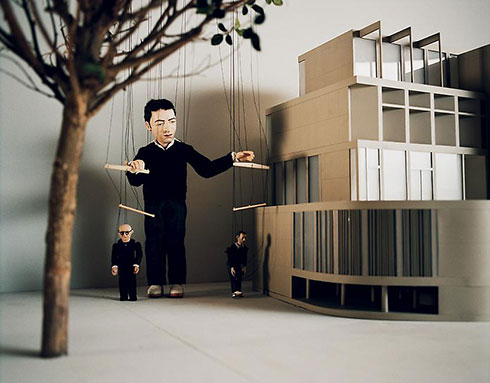
Art: This is not a time for dreaming, Pierre Huyghe, 2004.